
the great amir khusr0w loses his voice
A naansense story that goes from worse to worse to musical hell
by Labiba Ali
Princess of Blue Pavilion, Khamsa of Amir Khusrow, 1597, Met Museum.
Amir Khusrow is a historical figure. He served under seven Sultans of Delhi as a court poet and made significant contributions to North Indian Classical Music as well as Sufi Music. His ghazals and qawwalis (musical genres) remain popular to this day. He visited Bengal twice, once around 1279 CE and then around 1335 CE.
This is a fictional story.
13th century Delhi, North India
Amir Khusrow, the great Indian poet and musician, was perplexed. Early this morning just before dawn prayers, he had woken up from a disconcerting dream. Now at breakfast he was still ruminating about it. In his dream the Sufi Saint Moinuddin Chisti had appeared as a fakir and told him that tonight at 8:34 pm he will lose his voice for 6 hours. He gave no reason but simply disappeared into a smog of ganja.
This was not the first time the revered Saint had made a special appearance in his nightly dreams. There was the time when the Saint had warned him that he would be hit by an egg missile when he refused to sing after evening prayers on Basant Festival. And that other time when he foretold that Khusrow’s mother-in-law would be mildly poisoned with chutney by the neighbor’s wife.
But tonight he cannot afford to lose his voice. Tonight was the most sought-after event on the Delhi social calendar – a special mehfil at the Sultan’s court for the who’s who of Delhi’s cosmopolitan society. Khusrow will be presenting a new set of ghazals designed to give maximum delight to the senses and which he had specially composed in honor of the Sultan. If all goes well the Sultan has promised to promote him to chief court poet and pay off all his debts with the jewelers, where his wife was fond of shopping.
No, no, no….he cannot lose his voice tonight of all nights!
Since his Sufi master Nizamuddin Auliya was on vacation in Kashmir, he decided to visit his astrologer for some sound advice. A Brahmin from Varanasi, his astrologer was a Kalidas Chaturvedi, an esteemed Sanskrit scholar who had memorized all four Vedas back to front.
“Khusrow-saab this week Saturn is in an inauspicious conjunction in your chart. Saturn wants you to stay at home and repent all the times you forgot to sacrifice a goat in Saturn’s name during Eid.”
“But Kalidas-ji I must sing tonight. Is there no way to appease Saturn, even if for the next 17 hours? How about I compose a very complicated raga in 110 beats and name it Raga Majestic Saturn?”
“I’m afraid Khusrow-saab Saturn is livid and no amount of persuasion will convince him to relent. But there might be an upaiya – an offering of your favorite food to the Banyan Tree at the Shiva Temple at exactly 2:33pm might placate Saturn for the next 38 hours.”
Now Khusrow’s all-time favorite foods were Tandoor Naan and Lamb Gosht. Fortuitously the Central Asians, when fleeing to Delhi from the wrath of Chenghis, had managed to sneak out these two dishes along with the tandoor oven from Samarkand. With these new arrivals in Delhi, the cuisine had become a delicious fusion of Central Asian meats slow cooked in Afghan saffron and Indian bay leaves, much like Khusrow himself who was a juicy blend of a Central Asian father and an Indian mother.
At the thought of naan his nose flared up in anticipation, and he sprinted through the gullies of Delhi to the most popular naan store in all of Mehrauli. All the while the tower of Qutub Minar followed his every move closely but fondly. But as he approached Rumi’s Naan Store all he could see was a halo of black smoke. The tandoor oven had short circuited and burned all the naans. There will be no more naans until tomorrow.
Khusrow couldn’t believe his misfortune. Fed up with the disastrous day, he decided to go home and take a nap. Everything was always better after an afternoon siesta on his specially ordered 600-count cotton sheets.
Waking up two hours later he already felt better. Perhaps the Almighty will overrule Saturn and all will go well. With these pleasing thoughts he arrived at the palace in his Friday best – a turban of premium Bengal muslin that he bought on his last visit there and a tailored coat block printed specially for him in Gujrat.
In the music hall, his associate musicians had already arranged the instruments in the specific order that he had laid out in his 32-page instruction manual. The sitar, tabla, rubab, were all sitting in jovial harmony, perfectly in tune with each other. If only the Sultans and their sons got along a quarter as well, mused Khusrow, we could end patricide once and for all.
A sudden crashing noise broke through his self-indulging reverie.
Khusrow turned around. On the floor lay his treasured sitar and tabla smashed into a thousand pieces and covered in cumin infused lamb gosht curry. The kitchen staff had mistook the music hall for the dining hall and while maneuvering their large cast-iron cauldrons filled with curry crashed head on into the instruments.
Khusrow could no longer take it. An avalanche of frustration burst forth and he started yelling curses in a mix of Persian and Hindavi. After 22 minutes of continuous bilingual cursing, Khusrow’s voice began to croak. Very soon it turned hoarse. Finally, his voice went dead. It was exactly 8:34 pm.
Khusrow started to weep. His reputation in abysmal tatters how will he show this unlucky face to the Sultan? He continued to weep well into the night. As he walked home in depressing darkness, a distant voice whispered into his ears. It was his Sufi master.
“Do not weep O Khusrow, my beloved
Tonight is not the end
You bear the name of a great ancient King
And you will go down in history as the Parrot of India.
Seven centuries from now your music will be heard
by a nation called Gen Z.
And a tribe by the name of Bollywood will spread
your poetry to the four corners of the world.
Rejoice O Khusrow as this is only the beginning
of a very illustrious career.”
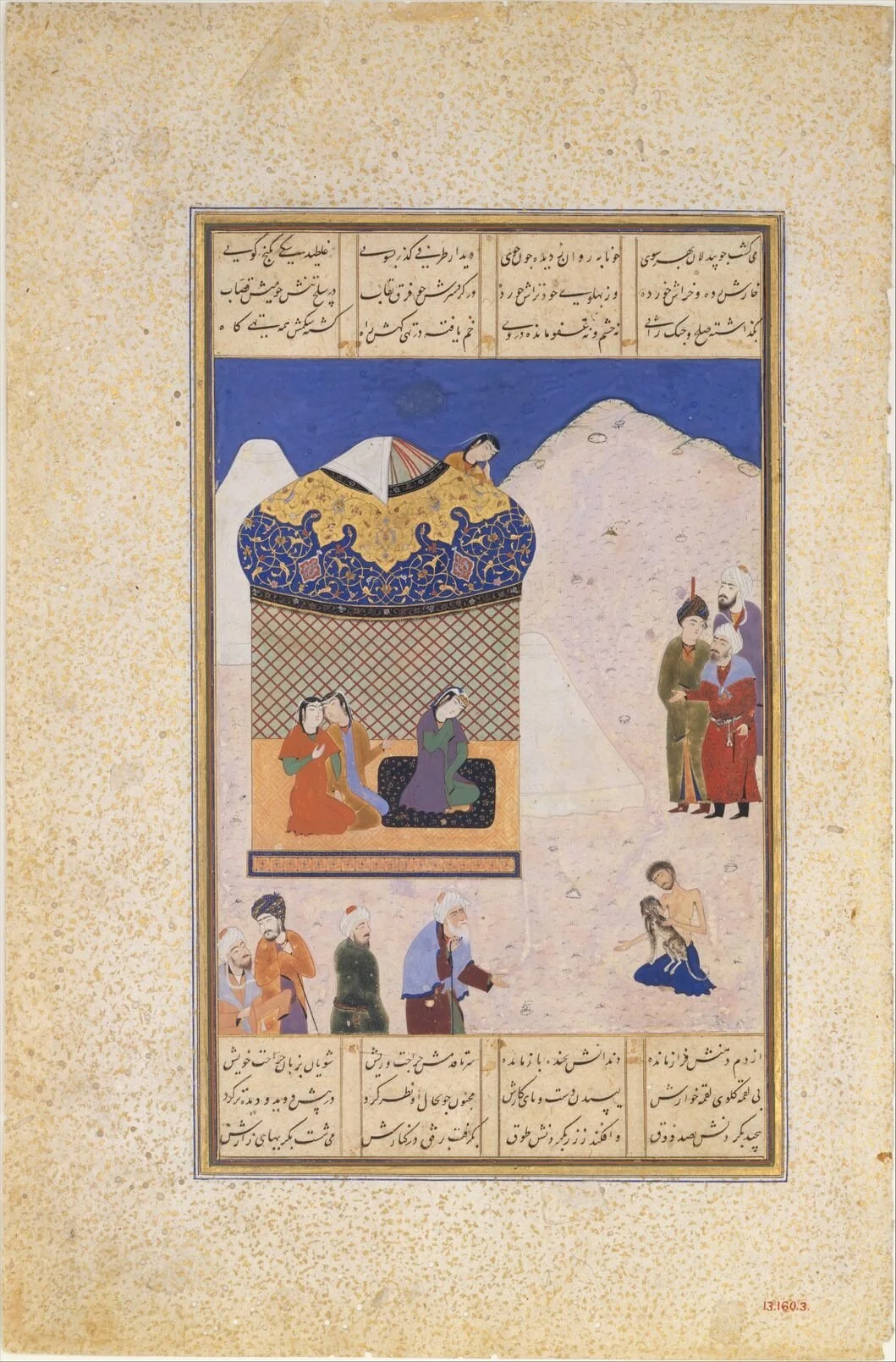
“Laila visiting Majnun in the desert”, Folio from a Khamsa (quintet) of Amir Khusrow, Herat, 1520-25, Met Museum.
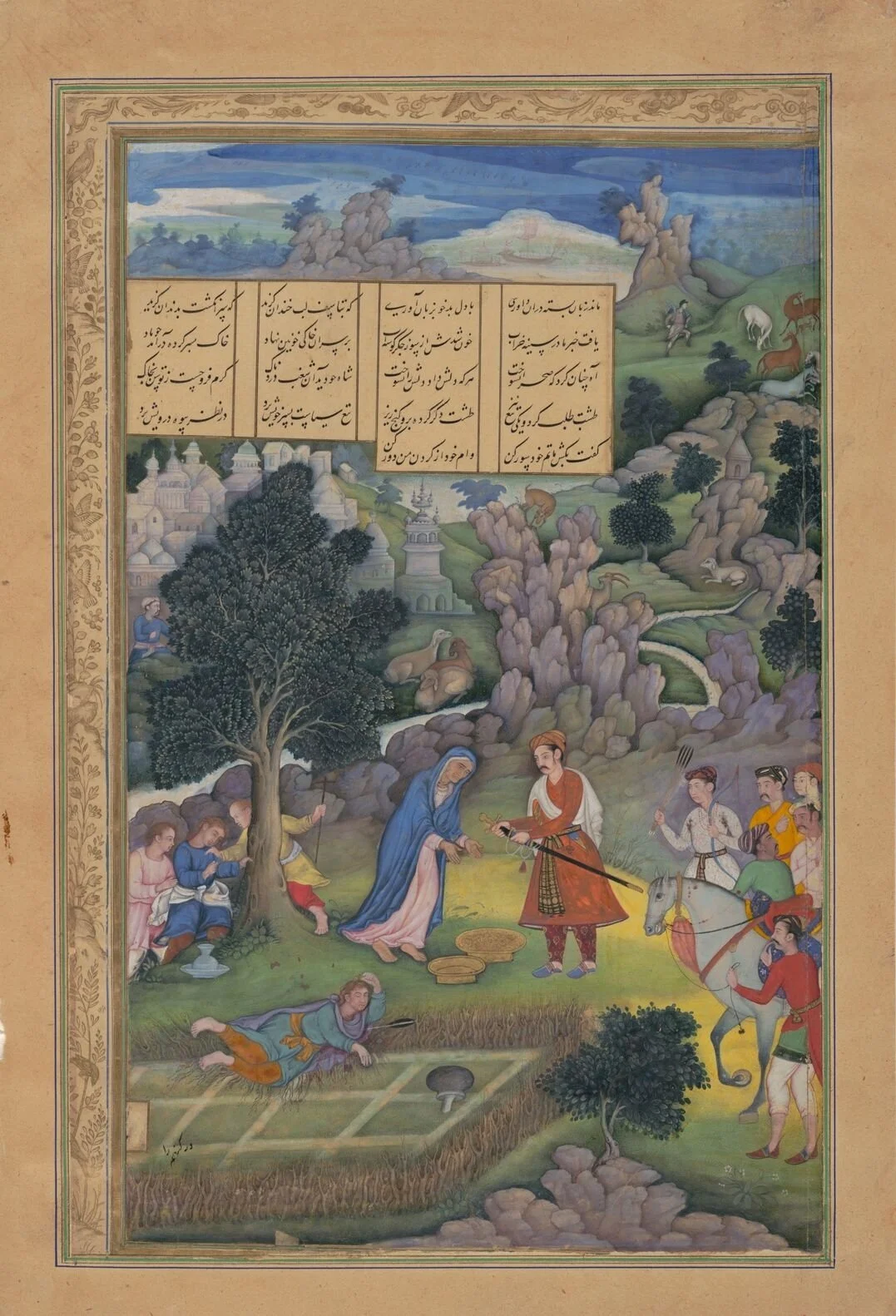
"A King Offers to Make Amends to a Bereaved Mother", Folio from a Khamsa (Quintet) of Amir Khusrow, Mughal Period, 1597-98, Met Museum.