bangladesh history chronology
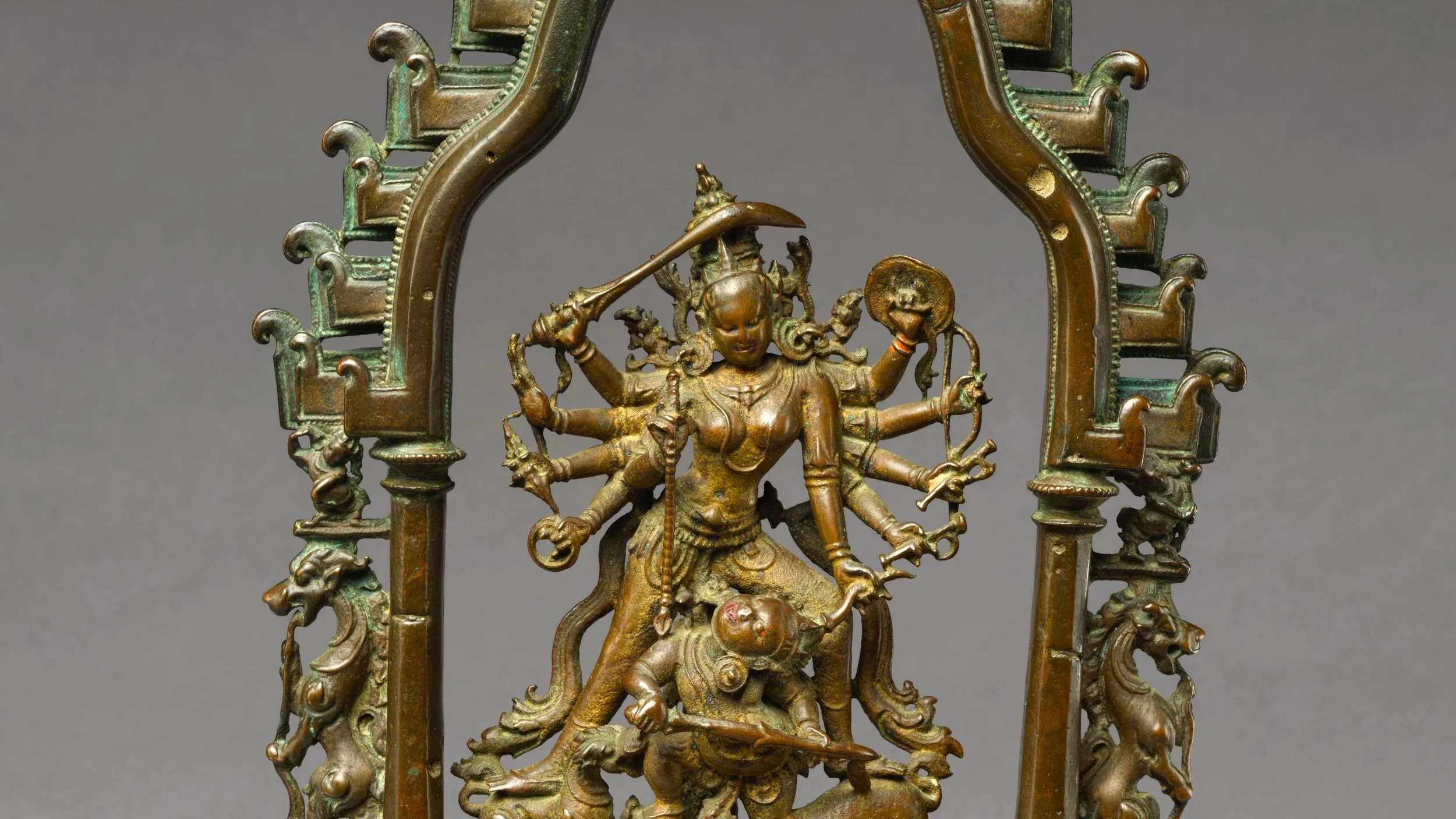
Goddess Durga, Pala-Sena Period, 12th century, MET Museum.
Pre - 1,500 BCE
Cultivation of irrigated rice and domestication of animals.
5th century BCE
Urban centers, long distance maritime trade, first sizeable states.
Indo-European languages and Sanskritic culture begin to spread from the west.
Regions of Bengal identified as Rarh, Pundra, Varendra, Gaur, Vanga, Samtata and Harikela.
4th - 2nd century BCE
Maurya Empire (Hindu/Buddhist)
First pan-Indian empire to consolidate the subcontinent into one polity.
Emperor Ashoka, most famous Mauryan ruler, establishes Buddhism as the state religion.
Mahastangarh founded in north-western Bangladesh which includes the ruins of the ancient city Pundranagar.
4th - 5th century CE
Gupta Empire (Hindu)
Second pan-Indian empire which ushers in a Golden Age when the arts flourished and Sanskrit high culture was exported to SE Asia.
Angkor Wat and Borobudur are examples of this cultural exchange between India and SE Asia.
7th century CE
Gauda Kingdom (Hindu)
Ruled by King Shashanka with the capital in present-day Murshidabad, West Bengal.
7th - 11th century CE
Pala Empire and Chandra Dynasty (Buddhist)
The Palas reign over western Bengal while the Chandras rule over eastern Bengal.
Paharpur Buddhist monastery established in north-western Bengal.
Mainamati Buddhist monastery established in eastern Bengal.
11th - 13th century CE
Sena Kingdom (Hindu)
Lakhnauti-Gaur in north-western Bengal was capital of the Senas.
1205 - 1342 CE
Delhi Sultanate (Muslim)
Lakhnauti-Gaur conquered by Muslims in 1206.
Bengal ruled by Delhi for the next 200 years.
1342 - 1575 CE
Bengal Sultanate (Muslim)
Secedes from Delhi and establishes an independent sultanate.
Ruled by a succession of Muslim Dynasties.
Consolidation of Bengal from different regions. First time the word ‘Bangala’ appears to describe the region.
1520s CE
First Europeans (Portuguese) settles in the Bengal delta.
1575 - 1713 CE
Mughal Empire (Muslim)
After more than a 25-year struggle against Bengalis, Mughals bring the entire Bengal under their domain by 1612.
Dhaka in central Bengal is founded as Jahangirnagar (named after 4th Mughal Emperor Jahangir) and becomes the capital of Bengal Subha, a province of Mughal India.
1713 CE
Nawabs of Bengal (Muslim)
Bengal becomes independent from Delhi under the Nawabs; the capital is moved to Murshidabad in western Bengal.
The Mughal Emperor in Delhi is now a nominal ruler with extremely limited power.
1757 CE
British East India Company
The Company defeats the Nawab of Bengal in the Battle of Plassey and becomes the de facto ruler of Bengal.
Calcutta (Kolkata) is the capital of Bengal. It later becomes the capital of British India (British Raj) from 1857 to 1911.
1857 CE
British Raj
The Sepoy Mutiny is the first independence movement against British rule.
The British crown takes over from the East India Company and British Raj officially begins.
Early 1900s CE
Nationalist movement takes off in British India.
Bengal is a stronghold for anti-colonial activities with prominent Bengali leaders such as Subhash Chandra Bose, Bipin Chandra Pal, AK Fazlul Huq.
1905 - 1911 CE
First partition of Bengal into two provinces: East Bengal & Assam and West Bengal.
Partition is reversed in 1911.
1947 CE
Independence from Britain.
Partition of British India into two modern nation states: Pakistan and India.
East Bengal becomes the easternmost province of Pakistan separated by India. West Bengal becomes a state of India.
1952 CE
Language Movement that gave official status to Bangla as a national language of Pakistan.
1971 CE
Independence from Pakistan.
Bangladesh founded as a People’s Republic.